We arrived at the Daughters of Charity Motherhouse around 1am. Nonna and I roomed together at each place we stayed. Our room was in somewhat poor condition. We stayed for two days and both days our showers were cold :/ I think cold showers might be one of the hardest sacrifices. When you’re used to enjoying your shower and instead it’s directly the opposite, it’s not fun.
Our first day in Peru was packed and exciting. First, we took a tour of the convent of St. Dominic (Convento Santa Domingo), where St. Martin de Porres lived and worked as a Dominican brother. St. Martin wasn’t the typical Dominican. Rather than teaching, he cooked for the brothers and the homeless, cleaned and cared for the sick and homeless. He founded an orphanage and a children’s hospital. Like St. Francis, he loved animals. He’s typically pictured holding a broom with a cat, dog and mouse at his feet sharing a bowl of milk. He was the illegitimate son of a Spanish gentleman and a freed woman of black descent from Panama. After the birth of his sister, Martin’s father abandoned his family and Martin was raised in poverty. Many miracles are attributed to St. Martin, he was known to bilocate and was the first African-American to be admitted to the Dominican order.

We also visited the tomb of St. Rose of Lima who lived during St. Martin’s time. In fact, the two were friends. The saint’s real name was Isabel, but because she was such a beautiful baby, she was nicknamed Rose. Her mother even put a wreath of flowers on her head to show off her beauty to friends as she got older. Rose had no desire to be admired however since she had chosen to give her life to God. Her love for Jesus was so great that her face and eyes glowed with joy when she talked about Him. Many times she was afraid her beauty would be a temptation to others since they couldn’t take their eyes off her, so she cut off her hair and would sometimes rub her face with pepper until it turned red and even blistered. Rose always humbly obeyed her parents and worked hard for them since her family was very poor. She was adamant against them however when they desired her to marry. She absolutely refused. Rose was often tempted by the devil and felt a terrible distance between herself and God. She always offered her sufferings to him though and bore them humbly. Many miracles followed her death and she became the first Catholic in the Americas to become a canonized saint. source


From the tomb of St. Rose we visited the tomb of St. Martin and Father celebrated mass for us there. It was our first mass celebrated in Peru, and what a special place to have it!


The above picture is our group in the chapel :)
Then we went to lunch. This was an interesting experience. It was a fixed menu with appetizers such as chicken soup, salad, etc. then a main course. On the main course menu there were pretty normal food options such as pesto noodles, beef and rice plates, etc. Then the last option on the menu was tripe. Yes, tripe. Do you know what tripe is? It’s cow stomach. I was feeling adventurous so I decided to try it. “We eat every other part of the cow right? What could be so different about the cow stomach?” I thought. I decided to order a normal dish as the appetizer, just to be safe, so I ordered chicken soup.
Well, my chicken soup arrived and what a surprise my eyes beheld. It was not your ordinary chicken soup. They stuck key chicken parts in there… whole! Take a look:

Yep, that’s a chicken foot. And somewhere else in that bowl, is a chicken heart and gizzard. Since Peru is such a poor country, every-day restaurants can’t afford to throw away half the animal, so they utilize as much as possible. Father, on the other hand, wasn’t surprised at all. Having lived in Peru for seven years, he told us he would eat it. “What! People actually eat it!” I thought it was just for flavoring or something but apparently not. “Well, if it’s normal here, maybe it’s not so bad.” So I mustered up my courage to take a bite. It was hardly a bite, I was so disgusted. I took a tiny bite right off the foot then didn’t touch it after that. It was entirely too foreign to me. This got me thinking… “Shoot, I ordered tripe for my main course… they’re probably going to slab a whole cow stomach on my plate.” Thankfully, this wasn’t the case. Instead they were broken up into pieces mixed with rice, potatoes and a special kind of sauce. I tried it, but I didn’t like it. The thought and the texture was enough for me. My conclusion: there is a different name for the cow stomach because it’s not like the rest of the cow. I didn’t finish it.
After lunch we took about a half hour bus ride to the Daughters of Charity orphanage in Lima. On the bus ride over we saw a hill covered with houses that we were told was the middle class...


Goes to show how poor Peru is huh?
Take a look at this picture too...

Notice the tops of the buildings are not finished: no roofs on the top floor. These houses are all over Peru. Our guide, Jorge, told us families purposefully don't finish their houses, since the government can't demand taxes on incomplete homes.
The Lima orphanage cares for both boys and girls ages 5-12 and four nuns care for the children there. They had been sent out from the Motherhouse (where we were staying). For those of you who are not familiar with how religious life works in the Catholic Church, sisters (nuns) start out in “training” so to speak during their early years, at the Motherhouse in preparation to be sent out on mission. After a certain amount of time, they are prepared to serve elsewhere. They are always in contact with the Motherhouse and may return for a time before being sent somewhere else. They may also return for retreats or other events.


Goes to show how poor Peru is huh?
Take a look at this picture too...
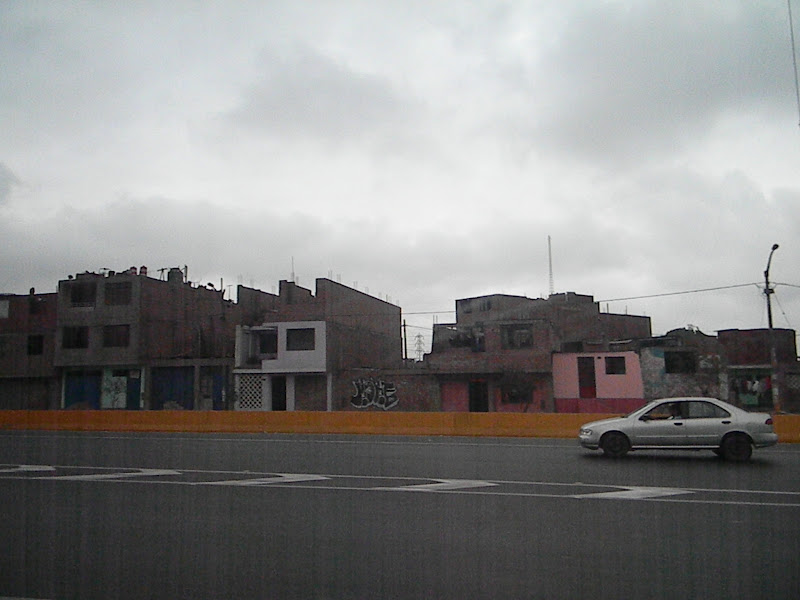
Notice the tops of the buildings are not finished: no roofs on the top floor. These houses are all over Peru. Our guide, Jorge, told us families purposefully don't finish their houses, since the government can't demand taxes on incomplete homes.
The Lima orphanage cares for both boys and girls ages 5-12 and four nuns care for the children there. They had been sent out from the Motherhouse (where we were staying). For those of you who are not familiar with how religious life works in the Catholic Church, sisters (nuns) start out in “training” so to speak during their early years, at the Motherhouse in preparation to be sent out on mission. After a certain amount of time, they are prepared to serve elsewhere. They are always in contact with the Motherhouse and may return for a time before being sent somewhere else. They may also return for retreats or other events.
These sisters were so sweet! Since it’s summertime in South America during December and January, all the orphans were home for summer break or with other family members. At first it seemed odd to me that they had families to go home to, since I thought “orphan” meant both parents were deceased. Father told us that this can be the case but that many children were actually taken to the orphanage by one parent who cannot care for the child. While some children return to visit immediate family members such as siblings or a parent, others will visit grandparents or other extended family. Even though there were no children there at the time, the sisters showed us around the orphanage and told us about their daily life. They raise guinea pigs, rabbits and chickens and we were allowed to hold them.. except for the chickens.


We also visited the Church of the Nazarenas where the image of Our Lady of Miracles is located. It’s a famous image of Christ painted by an African slave from Angola.




We also visited the Church of the Nazarenas where the image of Our Lady of Miracles is located. It’s a famous image of Christ painted by an African slave from Angola.

On the wall of a small church, the painting hung casually from 1651 to 1655 until an earthquake leveled the entire area except the wall where the painting hung. The wall and painting went unnoticed for a time until a man walking through the rubble noticed it and felt compelled to care for the painting. He was ill however and asked the Lord through the painting to heal him. God answered his prayer and the man was healed: the first miracle attributed to the famous painting. Word spread and it became a revered image throughout Peru and the world. Despite another earthquake and attempts to destroy the image, it was miraculously protected and still remains today. On October 18th every year, a procession is held through the streets of Lima and other festivities take place throughout the day. source
This visit to the Church of Our Lord of Miracles concluded our day in Lima and we returned to the Daughters of Charity Motherhouse in the evening.

